
BioWorks & Everde Growers-Glen Flora, Texas
Introduction:
Buxus microphylla japonica, Japanese Boxwood is susceptible to multiple fungal diseases with large losses to the crop during the heat of the summer. Rootshield Plus+ G (RS+) is a biological fungicide that provides preventive control of major root rot and damping off diseases such as Phytophthora, Pythium, Fusarium, Rhizoctonia, Cylindrocladium and Thielaviopsis. RootShield PLUS+ G features a patented combination of Trichoderma harzianum strain T-22 and Trichoderma virens strain G-41 to protect from a broader range of root diseases at a wider range of temperatures.
Objective
A trial was installed with RS+ applied as a topdress in June, July and August at Everde. These treatments had no positive results with 80% of the crop displaying disease symptoms. A trial by BioWorks with a grower in Florida showed a positive response when RS+ was incorporated in the media at canning.
Evaluate the response of newly canned 3G boxwoods with RS+ incorporated at a rate of 3 lbs/yd3. No additional fungicides were applied during the trial to the RS+ treatments. The RS+ population was compared to fungicide treated population (current fungicide rotation) in the field.
Study Design
- Rootshield rate: 3 lbs/yd3
- 208-3G Boxwood were canned with RS+ and placed in section 9019 (Figure 1).
- Control 1: Boxwood crop in section 9019 under fungicide rotation was planted
- Control 2: Boxwood crop in section 10004 under fungicide rotation was planted
- Control 3: 20 plants were removed from section 10004 and placed in the new products area where no fungicides were applied, and no RS+ was added.
- Trial evaluations ended
- Dry Weights
- Three samples of each treatment were collected and used for analysis.
- Soil was removed from the root systems, rinsed and placed in a craft paper bag.
- The samples were placed in a Hotpack Tru-Temp drying oven at 80oC (176oF) at the Texas A&M Horticulture Department and removed on a week later.
Results
- RS+ Treatment
- Of the 208 Boxwoods planted in the RS+ amended soil, only 2 plants (0.96%) showed symptoms of root disease and had to be discarded. This crop was next to the Control 1 planting where root disease symptoms were prevalent throughout the summer. Roots were white, healthy and abundant (Figure 2).
- When the plant samples were dried and root weights recorded, RS+ had an average weight of 445.08 which is statistically significant when compared to the other treatments (Table 1).
- Control 1
- 60% of the crop was scrapped during the summer due to disease issues
(communication with grower, Epitacio). Section 9019 does appear to have a drainage issue with standing water not draining in a timely manner (Figure 5). Our wet spring and early summer contributed to these conditions. Roots were inconsistent, there were some healthy roots while others were brown and rotting. The root systems did not consistently fill the pot.
- 60% of the crop was scrapped during the summer due to disease issues
- Control 2
- The boxwood crop in section 10004 performed much better than the control in section 9019. This section sits higher and drains better, the pots do not sit in standing water during heavy rain events (Figure 6). Minimal losses occurred during the trial. The roots systems looked better than section 9019 but not as full as RS+. The dry root weight for section 1004 was greater than section 9019. But they were not statistically different.
- Control 3
- 15% of the plants in this group showed symptoms of root rot. The roots did not fill the pot and were thin and brown (Figure 3).
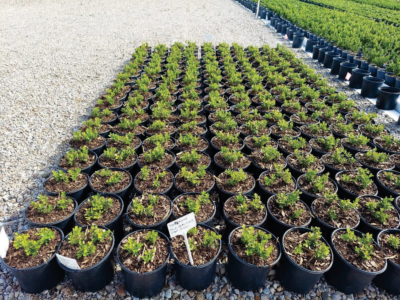
Figure 1. RS+ block in section 9019.
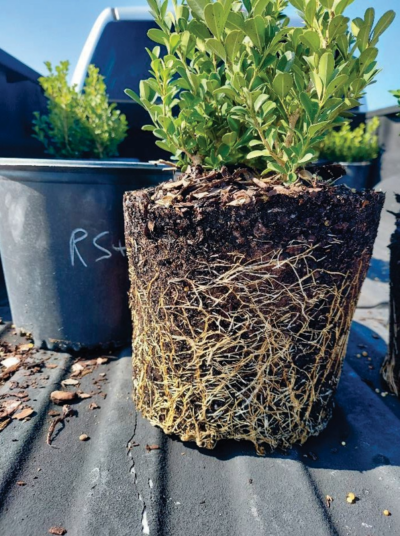
Figure 2. RS+ treatment
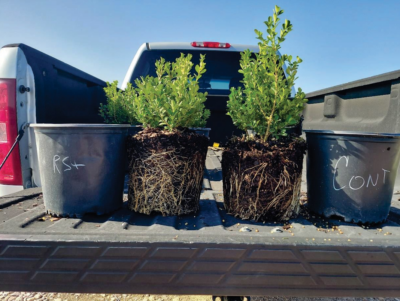
Figure 3. Comparison of RS+ treatment and Control 3
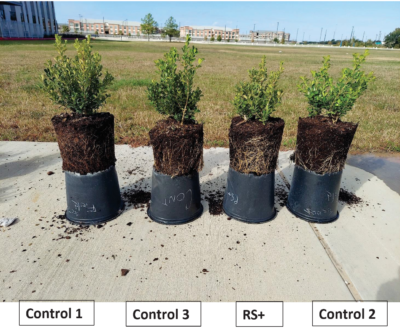
Figure 4. Comparison of all 4 samples
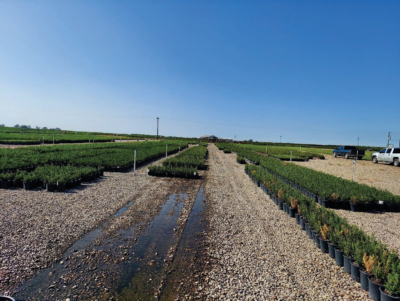
Figure 5. Standing water in section 9019 where scrappage rate was high.
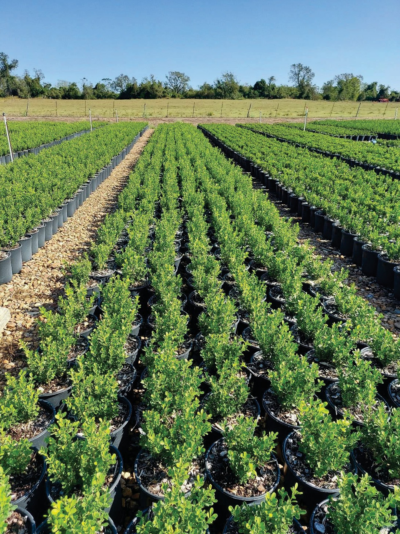
Figure 6. Boxwood crop in section 10004
Table 1. Average root dry weight of treatments.
| Treatment | Average Root Dry Weight (grams) |
| RS+ | 445.08a* |
| Control 1 | 189b |
| Control 2 | 306.17b |
| Control 3 | 211.68b |
P-value: 0.01834
*Tukey’s HSD test for pairwise comparisons.
Cost Estimate
- 500lb bag of RS+ is $5078.57 (per BWI)
- Cost/lb = $10.15
- Incorporation rate: 3lbs/yd3
- 1 yd3 of soil mix fills 100-3G pots (per canning manager, Facundo)
- Cost of incorporating 3lbs/yd3 = $30.45
- Cost per pot = $0.3045
Summary
The incorporation of RS+ significantly suppressed soil diseases in the boxwood trial, with only ~1% of plants showing symptoms and being discarded. Root dry weight was notably higher with RS+ compared to controls using the nursery’s fungicide rotation. The cost estimate of RS+ is $0.3045 per pot, which is likely minimal compared to the costs of multiple fungicide applications, REI and labor. Overall, RS+ appears to be a cost-effective method for producing healthy boxwoods during the summer.
Additional Trials
BioWorks recommends a soil incorporation rate of 1-3 lbs/yd3. This trial tested the highest rate (3 lbs), but evaluating lower rates (1, 1.5, and 2 lbs) could help determine if similar disease control can be achieved while reducing input costs.
Acknowledgements
Everde Growers: Dave Kerr, Bill Barr, Epitacio, Facundo
BioWorks: Sam Gray, Carlos Bogran